

Share this article
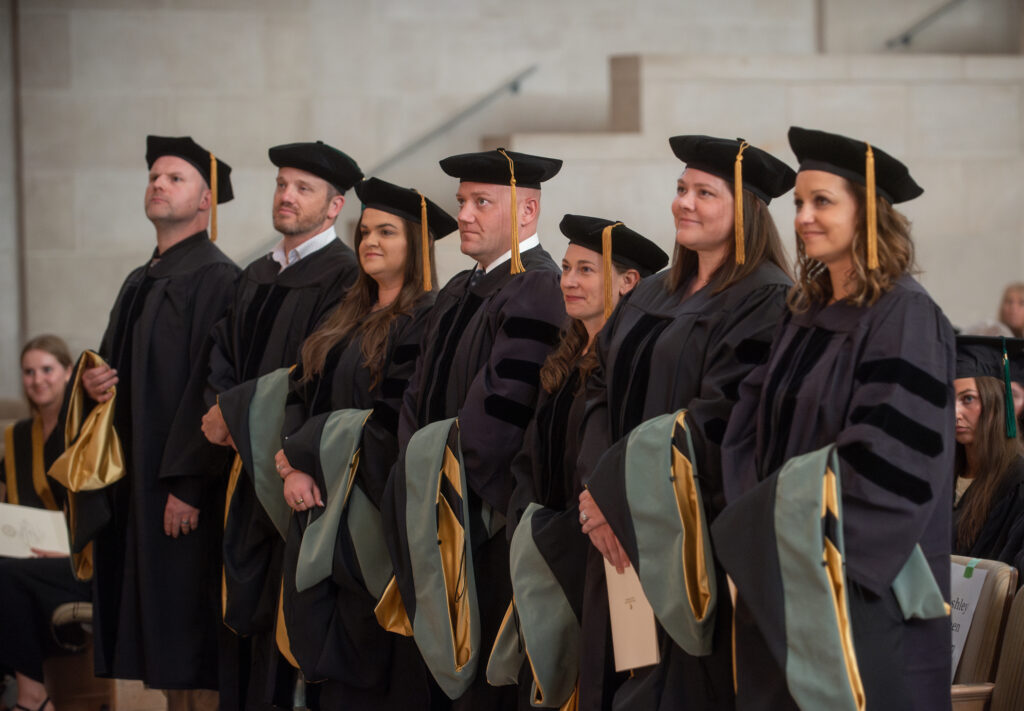
First grads include former firefighter and military service member in Hawaii.
Wake Forest University School of Medicine recently celebrated the first graduates of its Doctor of Medical Science (DMSc) program, marking a milestone for physician associates (PAs) seeking to advance their careers as healthcare leaders, researchers and educators.
Launched in 2024 through the Department of PA Studies, the fully online program allows practicing PAs to continue working while pursuing advanced training through leadership, research or education tracks. A defining feature of the program is its academically integrated approach with coursework through the Wake Forest University School of Medicine, School of Business and School of Law, along with a focus on PA-led research to improve healthcare delivery, education and practice.
“The Wake Forest University School of Medicine DMSc program was intentionally designed to move beyond a traditional post-professional doctorate by integrating multidisciplinary learning in leadership development, research, healthcare policy and finance,” says Natalie Smith, DMSc degree program director. “Our program is distinct in its ability to equip clinician-leaders to navigate complexity, drive change and fulfill our mission to help shape the future of healthcare and the PA profession.”
The first cohort researched topics ranging from improving triage protocols to understanding factors that influence a provider’s decision to precept or offer on-the-job training to students.
Peter Guertin, DMSc, EMCAQ, advanced practice provider leader with the Atrium Health Wake Forest Baptist Emergency Providers group, entered healthcare after careers as an EMT, paramedic and firefighter. He says the program’s practical focus on leadership and implementation science immediately strengthened his work.
“It’s not just me anymore making decisions for my patients — it’s me making decisions for my colleagues and, ultimately, the thousands of patients they serve,” says Guertin. “I learned something and took it back to work the next day, and I could use it immediately. When you combine real-world experience with formal training, that’s when you can truly make meaningful change in healthcare.”
Classmate Sloan W. Kelly, DMSc, PA-C, completed the program while serving on active duty with the U.S. military, finishing coursework after being reassigned from North Carolina to Hawaii. He credits the program with expanding his perspective beyond clinical practice.
“It really broadened my horizons of thinking in different ways from outside of the clinical realm and more through the lens of leadership and education, while learning how to apply new information as we’re integrating AI into everything, even in the military and medicine,” Kelly says. “It gave me more confidence of understanding how to research and how I could actually go through and build the process for it.”
From North Carolina to Hawaii, the inaugural graduates are already applying what they learned to strengthen healthcare organizations, advance research and improve patient care.
This story was originally published by Wake Forest University School of Medicine.